3 Counting and checking against the ledger
For everyone
- What a count is for, and why counting is blind.
- What short and over mean, and the usual reasons for each.
- Why a shortage is counted again, and why someone who didn’t count approves.
3.1 The idea
The ledger says what should be in the shop. A count, sometimes called a stock take, finds what is there. For each product, Jholok puts the two numbers side by side:
Comparing them, and explaining every difference, is called reconciliation. A count can cover the whole shop or just a few types. You give it a name, such as Showcase 1, but Jholok expects every piece of those types to be counted, wherever it is in the shop.
Short and over
When the two numbers agree, the product matched. When they don’t:
A difference is a question, not yet an answer. These are the usual reasons:
| What happened | What the count shows |
|---|---|
| A piece was stolen, lost or damaged | short |
| A sale wasn’t entered | short |
| A delivery wasn’t entered | over |
| A return wasn’t entered | over |
| A piece was put back in the wrong tray | short in one place, over in another |
| A counter missed a piece, or counted one twice | short or over |
| Something that isn’t the shop’s stock was in the tray, such as a customer’s piece in for repair | over |
Stock that goes missing without being sold is called shrinkage. A count is how a shop finds out how much it has lost.
Counting is blind
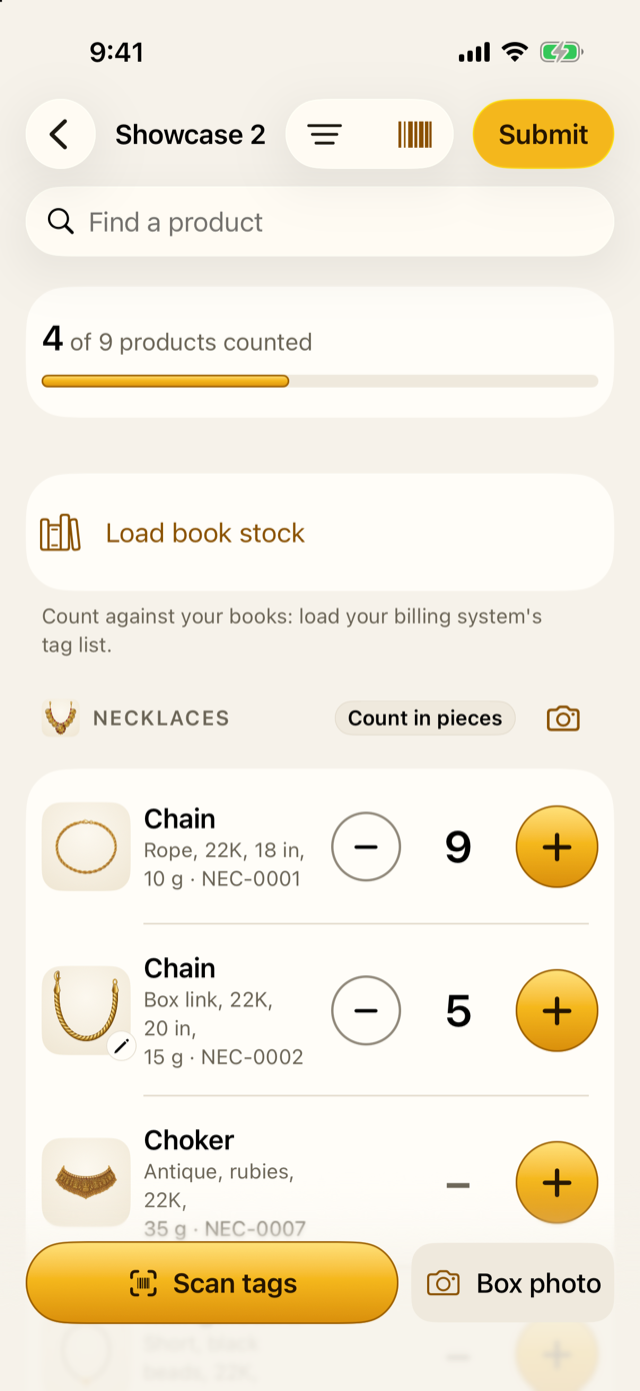
While a count is open, counters never see the expected numbers. People find what they expect to find: a counter who knows there should be 9 chains tends to stop at 9, or to look until a ninth turns up. A counter who doesn’t know just counts. That is called a blind count.
Two checks before stock changes
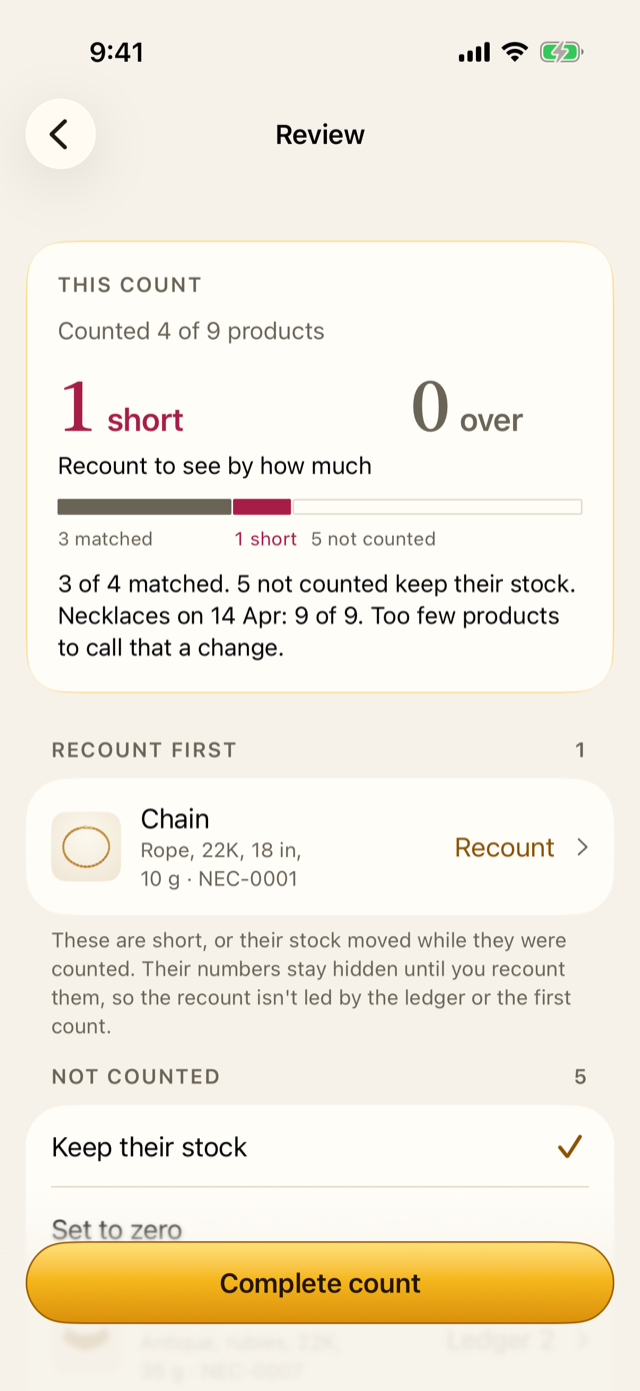
- A shortage is counted again first. Review won’t let anyone accept a shortage until the product is recounted, and the recount is blind too: the first count and the ledger stay hidden. Many shortages on a first count are counting slips, and a recount finds them before the stock is changed.
- Someone who didn’t count approves. The counter submits the count for review. Only an approver who didn’t count in it, or the owner, can open Review and complete it. They give a reason, then sign with their PIN (the owner can use Face ID). This is called separation of duties: the person who might have lost a piece isn’t the one who decides it is lost.
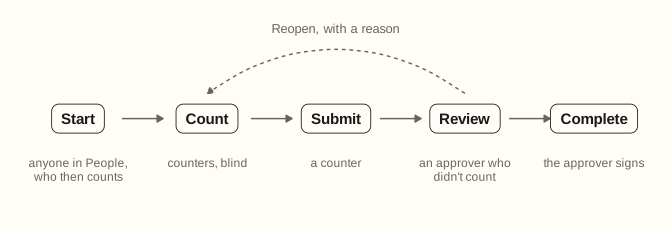
What completing a count changes
Completing a count changes stock only for the differences the approver left ticked. Each one becomes a count adjustment in the ledger, so stock is still a sum of movements. Products in the count that nobody counted keep their stock, unless the approver chooses Set to zero.
Overs start unticked. An over is often a missing record (a delivery or a return nobody entered), and the right fix is to enter that record, not to make the stock up to the count.
3.2 In the app
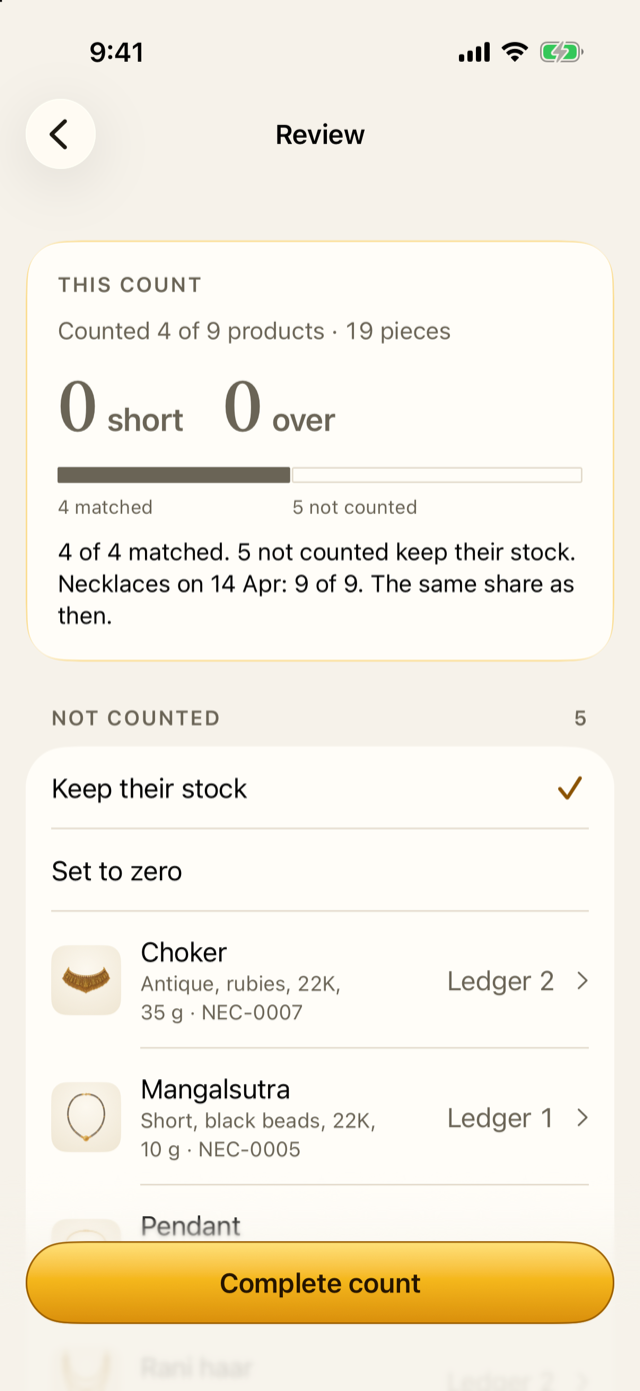
Review puts the counted and expected numbers side by side, and lists the differences.
A shortage, or a line whose stock moved while it was being counted, waits under Recount first, with its numbers hidden until it is recounted.
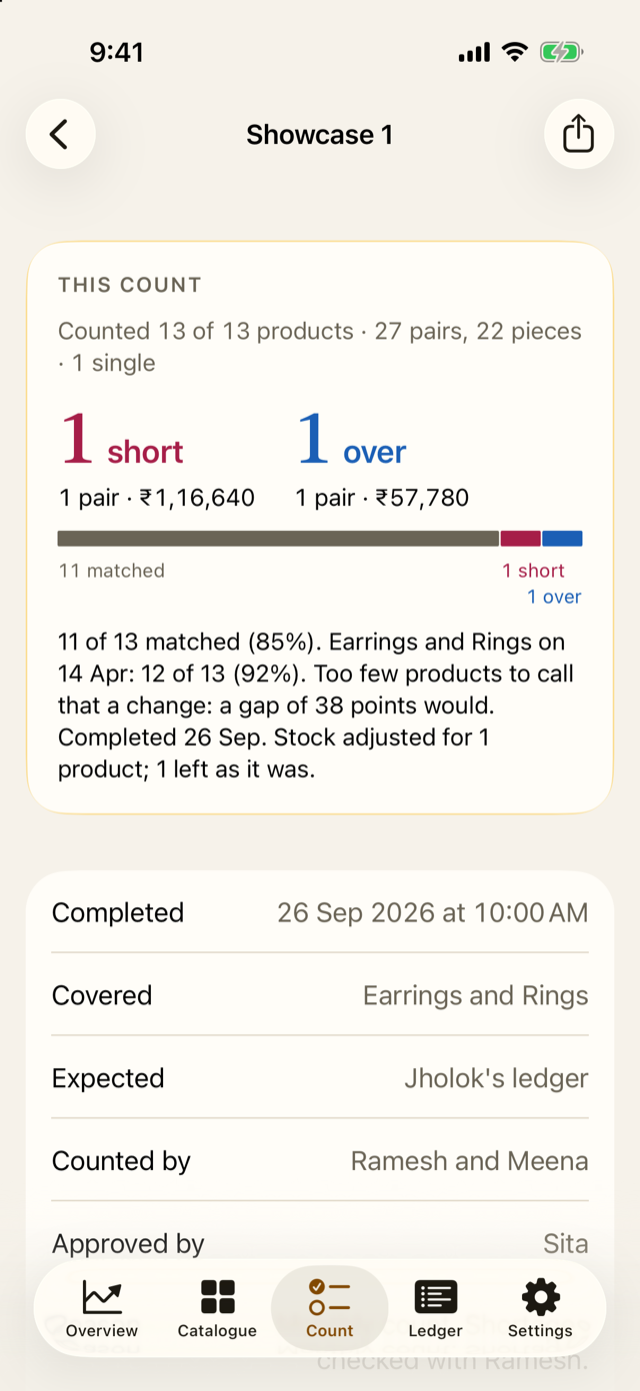
When the count is completed, its Result says what was counted, what was short and over, and what changed. This is the demo’s count at Showcase 1 on 26 September.
3.3 Why it works this way
- Blind counts are honest counts. Knowing the answer changes what people find.
- A loss someone counted is never accepted on one count. Shortages cost the shop money, and a recount is cheap. (Products nobody counted are different: they keep their stock unless the approver chooses Set to zero.)
- Two people, not one. One person can’t count a loss away and approve it too. The activity log records who counted, who approved and why.
- Short and over are kept apart. If a shortage of ₹1,16,640 and an over of ₹57,780 were netted into one figure, a real loss would hide behind something that isn’t stock at all.
- No percentages on small numbers. Jholok writes “3 of 4 matched” rather than 75% when fewer than 10 products were counted, because a percentage of a handful sounds more certain than it is.
3.4 How it works
At Showcase 1, the counters counted 13 products of Earrings and Rings, and 11 matched: Jholok writes that as “11 of 13 matched (85%)”. The jhumka (Antique, 22K, 8 g) was one pair short. It was recounted, still one short, and the approver accepted it: a count adjustment of −1. The hoop (Hammered, 22K, 15 mm, 4 g) was one pair over. The count’s note explains why: a customer’s repair piece was in the tray. It wasn’t the shop’s stock, so the over was left unticked and the stock didn’t change.
3.5 Try it
Suppose the earrings and rings are counted at the end of the demo’s story. Unknown to anyone, a pair of diamond flower studs has gone missing. A counter also counts one plain band twice, and finds a single chandbali earring on its own.
| Product | Expected | Counted | Difference |
|---|---|---|---|
| Stud, Diamond flower, 18K, 0.20 ct | 3 pairs | 2 pairs | short ₹41,870 at cost |
| Band, Plain, 22K, 4 g | 11 pieces | 12 pieces | over ₹57,240 at cost |
11 of 13 products matched (85%). The studs show short 1 pair, and the band shows over 1 piece. The single chandbali isn’t counted as a pair: the counter enters the whole pairs as usual and adds the single earring with Singles in the count sheet. Review shows it beside the pairs (“+ 1 single”), so the approver can look into it, and it changes no stock.
Review asks for the studs to be recounted. The band is over, so it starts unticked. The approver asks for it to be counted again too. On the recount, the band matches: the over was a counting slip. The studs are still one pair short, so the loss is real. After the recount, 12 of 13 products match, and the approver accepts the shortage of ₹41,870 at cost.
Question. A count finds one gold coin more than expected. What should you check before accepting it?
TipAnswer
Whether a delivery or a return of coins hasn’t been entered, and whether the coin is really the shop’s (a customer’s, say). If a record is missing, enter it and leave the over unticked: the ledger then matches the count without a count adjustment.
- A count compares what the ledger expects with what is really there.
- Counting is blind: counters never see the expected numbers.
- A difference is a question. A shortage is recounted before it’s accepted, and an over usually means a missing record.
- Someone who didn’t count approves, and only the differences they tick change the stock.