1 Stock basics
For everyone
- What a product is, and what its SKU is for.
- Why earrings are counted in pairs and sets as one.
- What cost, list price and stock value mean.
1.1 The idea
Your stock is the jewellery the shop owns and means to sell. To look after it, you need to know three things about every piece: what it is, how many of it there are, and what it’s worth. This chapter covers the first and the last. How many there are is the subject of the next two chapters.
Products and SKUs
Each design the shop sells is a product. A product is one design, in one metal and one weight, so that every piece of it is alike. The Temple Lakshmi jhumka in 22K gold weighing 14 g is one product. The antique jhumka in 22K weighing 8 g is another, even though both are jhumkas.
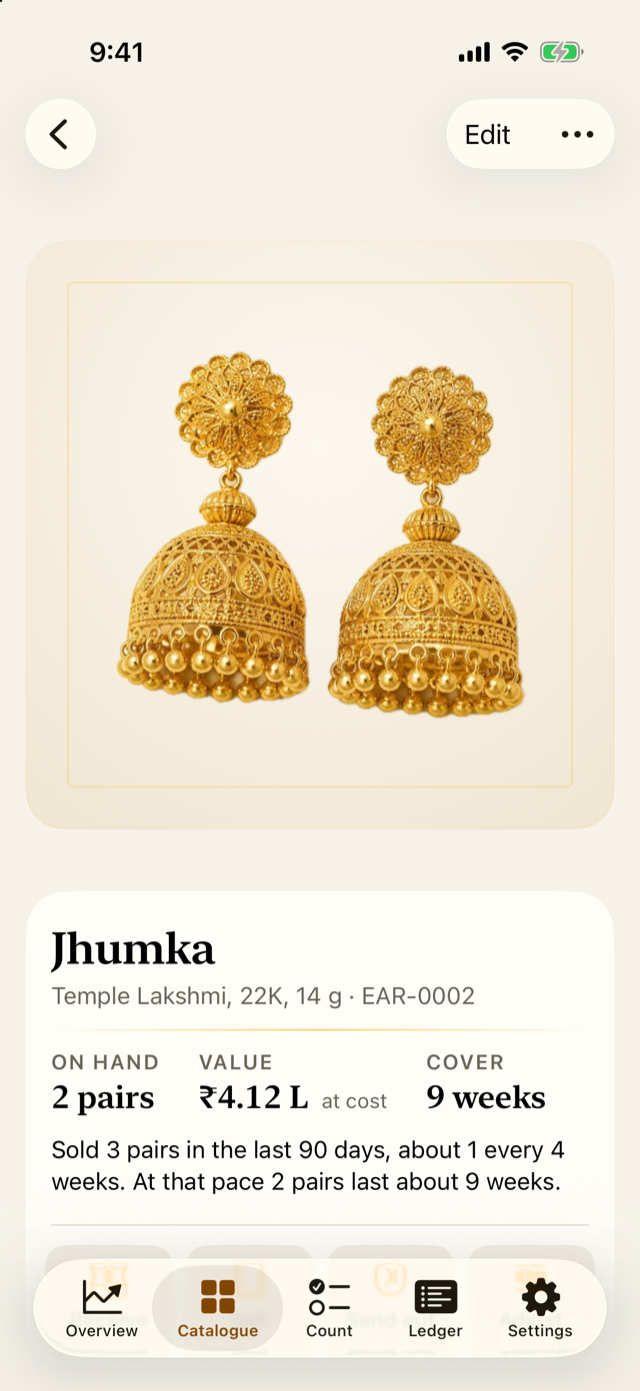
Each product has a short code called its SKU, which stands for stock keeping unit. The Temple Lakshmi jhumka’s SKU is EAR-0002. A SKU belongs to one product only. You can change it with Edit, but it is best to keep it the same, because labels and files use it. Jholok treats small and capital letters as the same, so ear-0002 is the same SKU as EAR-0002. When you add a product, Jholok suggests a SKU from its type (EAR for earrings, RIN for rings), or you can use your own codes.
How many of a product the shop holds is its stock on hand.
Types and units
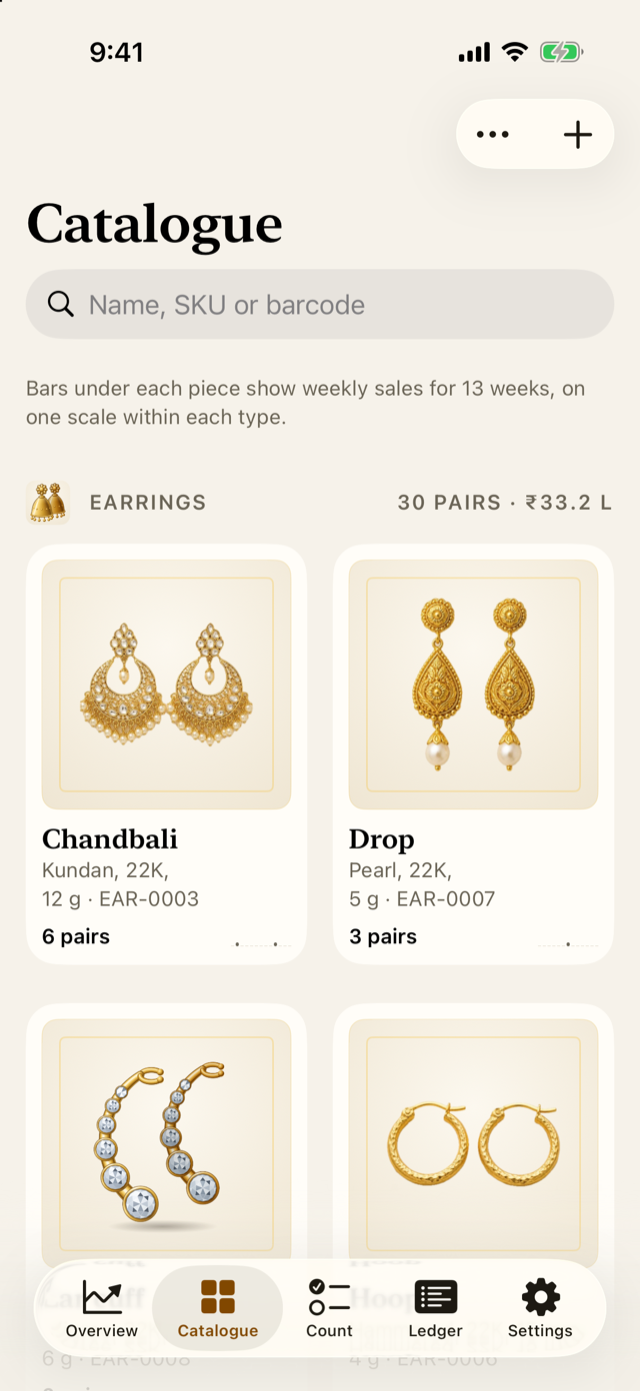
Products are grouped into types: in the demo shop these are Earrings, Rings, Necklaces, Bangles, Sets, Coins and Other. A type decides the unit its products are counted in:
- Earrings are counted in pairs. A pair is sold together, so it is counted together. A single earring found on its own is not half a pair, so it is never rounded into one: count the whole pairs, and add the single with Singles in the count sheet. It shows beside the pairs (“5 pairs + 1 single”), the approver sees it in Review, and it never changes stock.
- Sets are counted as one. A necklace with its matching earrings is one set, and counts as 1, because it is sold as one.
- Everything else is counted in pieces: a ring, a chain, a coin.
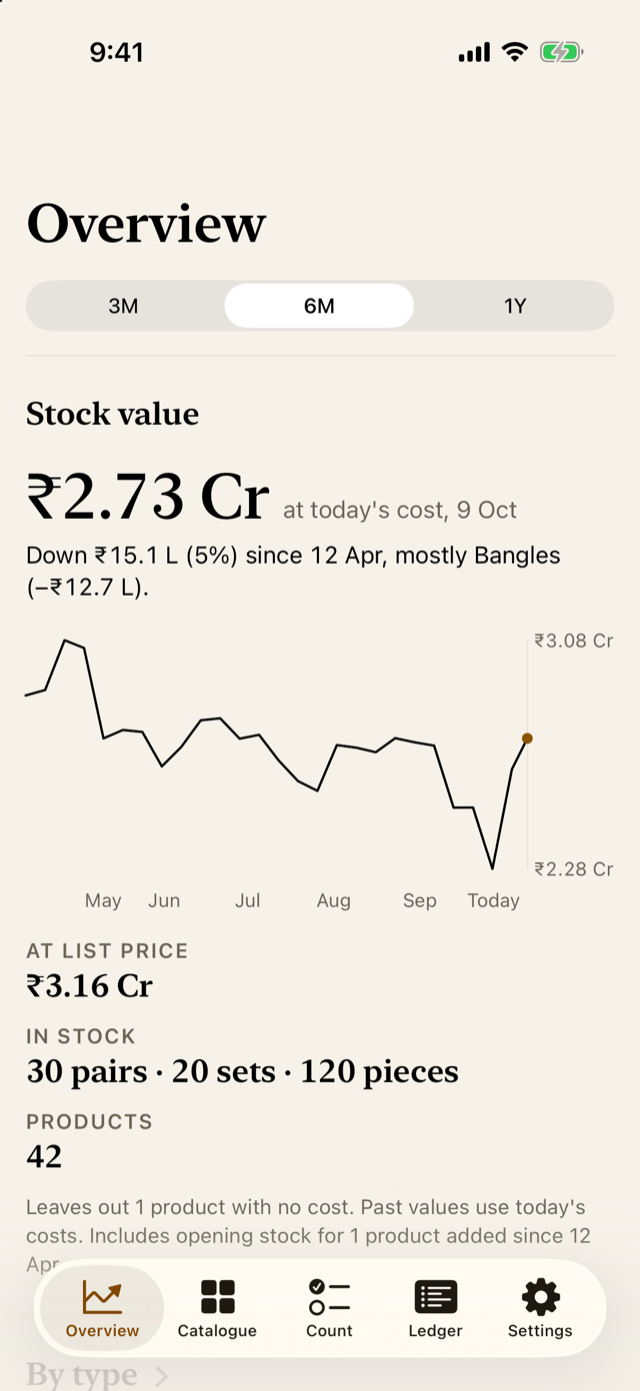
Because the units are different, Jholok keeps them apart when it says what is in stock: “30 pairs · 20 sets · 120 pieces”, not one total. Adding a pair of studs to a bridal set gives a number that means little.
Jholok never adds them into one count of items, even for sales. Where several kinds sold, it lists each, such as “18 pairs and 13 pieces”. Where a rupee value says enough, as in “Last week sold ₹7.79 L”, it gives the value alone.
Cost, list price and value
Each product can have two amounts:
- its cost: what the shop paid for one, with the gold, the making charge and any stones included;
- its list price: what the shop asks a customer for one (the product page calls it Price).
Stock value is what the stock is worth: each product’s stock on hand times its cost, added up. Value at cost is what the shop has paid for the stock it holds. Value at list price is what it would take if everything sold at the list price. The gap between the two is the shop’s margin.
Large amounts are written in lakh and crore, as in the app. One lakh (L) is ₹1,00,000, and one crore (Cr) is 100 lakh, or ₹1,00,00,000.
1.2 In the app
The Catalogue tab lists the products, grouped by type.
Tap a product to open its page. The Temple Lakshmi jhumka has 2 pairs on hand. Its value, ₹4.12 L at cost, is 2 × ₹2,06,010. Cover says how long the stock lasts at the pace it has sold recently.
The Overview tab shows the whole shop: its stock value at cost, ₹2.73 Cr, and at list price, ₹3.16 Cr, and what is in stock, by unit.
1.3 Why it works this way
- Stock is kept in its units so that every total means something. “20 sets” tells you something; “170 items” doesn’t.
- A value always says what it is based on, and when. Value at cost and value at list price differ by the shop’s margin, and gold prices move. So Jholok writes “₹2.73 Cr at today’s cost, 9 Oct”, with its date, never just a figure.
- Nothing is left out quietly. One product in the demo shop has no cost, so the Overview says “Leaves out 1 product with no cost” rather than counting it as ₹0.
1.4 How it works
For each product, Jholok multiplies its stock on hand by its cost (or its list price) and adds the results. Stock on hand itself isn’t stored anywhere: Jholok works it out from the ledger, as the next chapter explains. If a product’s stock has gone below zero (a mistake the next chapter also covers), it counts as none in the value, because no shelf holds minus one pendant.
1.5 Try it
This is Jholok Jewellers’ stock at the end of the demo’s story, by type.
| Type | In stock | At cost | At list price |
|---|---|---|---|
| Earrings | 30 pairs | ₹33.2 L | ₹37.8 L |
| Rings | 21 pieces | ₹16.5 L | ₹18.7 L |
| Necklaces | 25 pieces | ₹67.0 L | ₹75.5 L |
| Bangles | 23 pieces | ₹46.7 L | ₹51.7 L |
| Sets | 20 sets | ₹95.5 L | ₹1.08 Cr |
| Coins | 36 pieces | ₹9.74 L | ₹9.68 L |
| Other | 15 pieces | ₹4.83 L | ₹14.0 L |
The shop holds only 20 sets, but they hold 35% of its value at cost, because each set is heavy and costly.
Question. The antique jhumka (EAR-0001) costs ₹1,16,640 a pair, and the shop has 8 pairs. What are they worth at cost?
TipAnswer
8 × ₹1,16,640 = ₹9,33,120, which the app writes as ₹9.33 L.
- One design is one product, with its own SKU.
- Earrings are counted in pairs, sets as one and the rest in pieces, and stock is shown in those units, not as one total.
- Stock value is stock on hand times cost (or list price). It always says which, and from when.